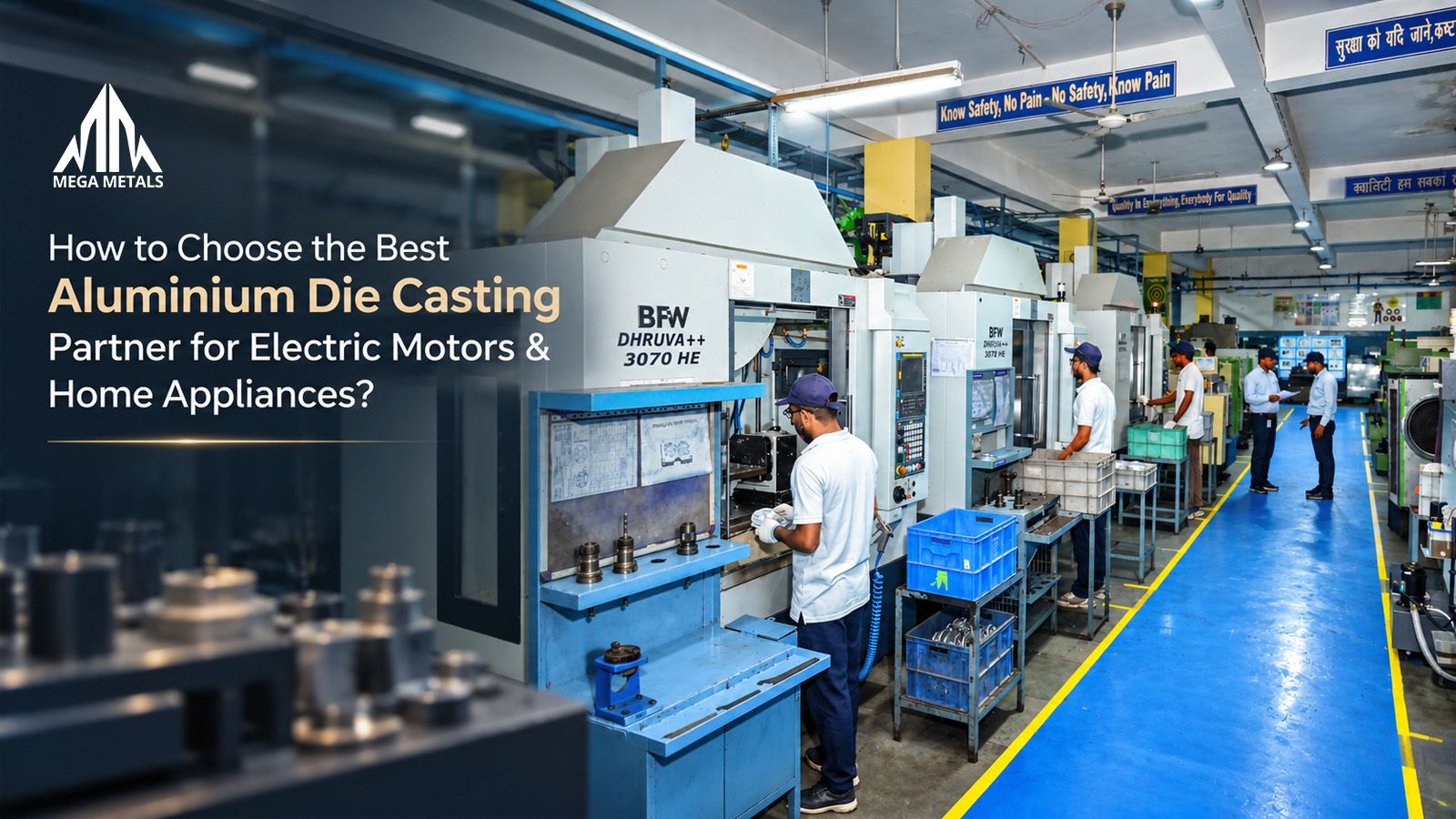
Modern manufacturing industries depend on lightweight, durable and precision-engineered components. Electric Motors & Home Appliances, power tools, automotive systems and industrial equipment all require components that can deliver consistent performance while meeting demanding production requirements.
For manufacturers and OEMs, choosing the right aluminium die casting partner can therefore have a direct impact on product quality, production efficiency and long-term reliability.
But how do you choose the right manufacturer?
If you are looking for Aluminium Die Casting for Electric Motors, power tools or home appliances, it is important to evaluate a manufacturer's technical capabilities, quality processes, customization options and production infrastructure.
Mega Metals India provides aluminium die casting and precision machining solutions for industries including electric motors, power tools and home appliances.
What Is Aluminium Die Casting?
Aluminium die casting is a manufacturing process in which molten aluminium is injected into a precision-engineered die under high pressure. The process allows manufacturers to produce complex components with consistent dimensions, detailed geometries and a high-quality surface finish.
High-pressure die casting can be particularly useful for high-volume manufacturing where repeatability, production speed and dimensional consistency are important.
Mega Metals' manufacturing capabilities include aluminium high-pressure die casting, machining and engineering support for precision components.
Why Is Aluminium Die Casting Important for Electric Motors?
Electric motors need components that can combine structural strength, dimensional accuracy and effective thermal management.
Aluminium is widely used for motor-related components because of its lightweight characteristics and thermal conductivity.
Aluminium Die Casting for Electric Motors can be used for components such as:
- Motor housings
- Motor frames
- End covers
- Stator housings
- Cooling components
- Mounting brackets
- Electrical enclosures
- Other precision-engineered motor components
The right die casting process can help manufacturers achieve complex shapes while maintaining production consistency.
Mega Metals' existing manufacturing capabilities include products such as heavy industrial motor end-covers and other precision aluminium castings.
Why Is Aluminium Suitable for Power Tools & Home Appliances?
The requirements of Power Tools & Home Appliances are different from those of many heavy industrial products, but manufacturers still need components that are lightweight, durable and accurately manufactured.
Aluminium die casting can help produce components with:
Lightweight Construction
Reducing component weight can be important for portable power tools and various consumer products.
Strength and Durability
Precision aluminium components can provide the structural properties required for demanding applications.
Thermal Management
Aluminium's thermal conductivity can make it useful for components where heat dissipation is an important design consideration.
Complex Designs
Die casting can produce complex geometries and integrated features that may be difficult to manufacture economically using some alternative processes.
Consistent Production
For high-volume manufacturing, repeatable die casting processes can help maintain consistent component dimensions and quality.
Mega Metals specifically identifies Power Tools and Home Appliances among the industries it serves.
What Makes Aluminium Die Casting Best for Electric Motors?
When manufacturers search for Best for Electric Motors, they are often looking for a combination of material performance, precision manufacturing and production reliability.
A suitable aluminium die casting solution should provide:
- Consistent dimensional accuracy
- Reliable material quality
- Efficient heat dissipation
- Lightweight component design
- Complex geometry capability
- Repeatable production
- Appropriate surface finish
- Machining capability where required
- Quality inspection throughout production
The manufacturing process should also be selected according to the component's geometry, production volume, dimensional requirements and application.
What Should You Look for in an Aluminium Die Casting Manufacturer?
Choosing a die casting manufacturer should involve more than comparing prices.
Here are some important factors to consider.
1. Manufacturing Infrastructure
A capable manufacturer should have modern die casting equipment and an infrastructure suitable for the required production volume and component size.
Mega Metals states that its aluminium casting capabilities extend up to approximately 900T tonnage, with features including advanced cooling systems, integrated die management and high-speed cycle capabilities.
2. Engineering & Design Support
Good manufacturing starts before the first casting is produced.
Engineering teams should be able to review component designs, understand application requirements and identify opportunities to improve manufacturability.
Mega Metals has an in-house engineering and design facility using CAD, simulation and 3D CAM capabilities.
3. Precision Machining
Some die-cast components require additional machining to achieve specific dimensional or functional requirements.
Mega Metals combines aluminium casting with machining capabilities, including advanced machining equipment and 4th- and 5th-axis machines.
4. Quality Control
Quality should be maintained throughout the manufacturing process rather than checked only at the end.
Important quality activities can include:
- Dimensional inspection
- Material verification
- Process monitoring
- Tooling inspection
- Component testing
- Final quality checks
Mega Metals describes quality control and dimensional inspection as important parts of its manufacturing process.
5. Custom Manufacturing Capability
Different electric motors, power tools and appliances require different component designs.
A manufacturer should therefore be able to develop components according to customer drawings, specifications and application requirements.
Mega Metals provides customized aluminium component solutions across its served industries.
Aluminium Die Casting Applications Across Electric Motors & Home Appliances
The versatility of aluminium die casting makes it useful across several industries.
Electric Motor Industry
Aluminium castings can be used in motor housings, frames, end covers and other structural or thermal-management components.
Power Tools
Power tools require components that balance strength, weight and durability. Aluminium die casting can support the production of complex housings and structural parts.
Home Appliances
Aluminium components are used across a range of appliances and equipment where lightweight construction, durability and thermal performance are important.
Mega Metals' home-appliance applications include components for washing machines, refrigerators, air conditioners, induction cooktops, mixer grinders, water purifiers and other domestic appliances.
Why Choose Mega Metals for Aluminium Die Casting?
Mega Metals India focuses on precision-engineered aluminium components for multiple high-growth manufacturing sectors.
Its capabilities include:
- Aluminium high-pressure die casting
- Precision CNC machining
- Tool and die development
- Engineering and design support
- Custom aluminium components
- Quality inspection
- Large-scale manufacturing
The company currently serves industries including electric motors, power tools, home appliances, automotive, electric vehicles, construction equipment, furniture and agricultural machinery.
For manufacturers looking for Aluminium Die Casting for Electric Motors, the ability to combine casting, machining and engineering support can simplify the manufacturing process and improve consistency.
How Does the Aluminium Die Casting Process Work?
A typical high-pressure aluminium die casting process involves several stages.
Step 1: Product Design
The component is designed according to its application, dimensions, tolerances and performance requirements.
Step 2: Die Development
A precision die is developed based on the component's geometry and manufacturing requirements.
Step 3: Aluminium Melting
Aluminium is heated to the required temperature before being transferred to the die casting machine.
Step 4: High-Pressure Injection
Molten aluminium is injected into the die cavity at high speed and pressure.
Step 5: Solidification
The aluminium solidifies inside the die while pressure is maintained to help produce the required component geometry.
Step 6: Ejection and Trimming
The casting is removed from the die and excess material or flash is trimmed.
Step 7: Machining and Finishing
Where required, additional machining and surface finishing processes are performed.
Step 8: Inspection
The finished component is inspected against the required specifications.
Mega Metals' knowledge centre describes HPDC as a repeatable process involving die preparation, metal ladling, injection, solidification under pressure, ejection, trimming and finishing.
How Can Manufacturers Reduce Aluminium Die Casting Costs?
Cost should be evaluated across the complete production lifecycle rather than simply comparing the initial casting price.
Manufacturers can potentially improve cost efficiency by:
- Optimizing component design
- Reducing unnecessary machining
- Selecting appropriate wall thickness
- Designing for efficient die filling
- Reducing unnecessary secondary operations
- Using suitable tooling strategies
- Selecting the right production volume
- Maintaining consistent process parameters
Early engineering and design evaluation can therefore be valuable when developing components for electric motors, power tools and home appliances.
Frequently Asked Questions
What is aluminium die casting used for?
Aluminium die casting is used to manufacture precision components for industries such as electric motors, power tools, home appliances, automotive, electric vehicles, HVAC and industrial equipment.
Why is aluminium die casting suitable for electric motors?
Aluminium offers lightweight construction, thermal conductivity, corrosion resistance and a useful strength-to-weight ratio. Die casting can also produce complex and repeatable component geometries.
What components can be manufactured through aluminium die casting for electric motors?
Depending on the design and application, components can include motor housings, frames, end covers, stator housings, brackets, cooling components and electrical enclosures.
Is aluminium die casting suitable for power tools?
Yes. Aluminium die casting can be used for selected power-tool components where lightweight construction, strength, durability and complex geometries are required.
Is aluminium die casting used in home appliances?
Yes. Aluminium die-cast components can be used across various home appliances, including air conditioners, refrigerators, washing machines, kitchen appliances and water-purification equipment.
Conclusion
Choosing the right manufacturing partner is an important step when developing components for Electric Motors & Home Appliances, power tools and other high-performance applications.
Aluminium Die Casting for Electric Motors can provide a practical combination of lightweight construction, precision, thermal performance and production efficiency. For power tools and home appliances, aluminium die casting can also support the production of durable and complex components at scale.
Mega Metals combines aluminium high-pressure die casting, engineering, tooling, machining and quality-control capabilities to support customized component manufacturing across multiple industries.
If your business is looking for an aluminium manufacturing partner that can support Best for Electric Motors, Power Tools & Home Appliances, Mega Metals India can be considered for precision aluminium casting and machining requirements.